Home / Under Cabinet Lighting Options
Under Cabinet Lighting Options
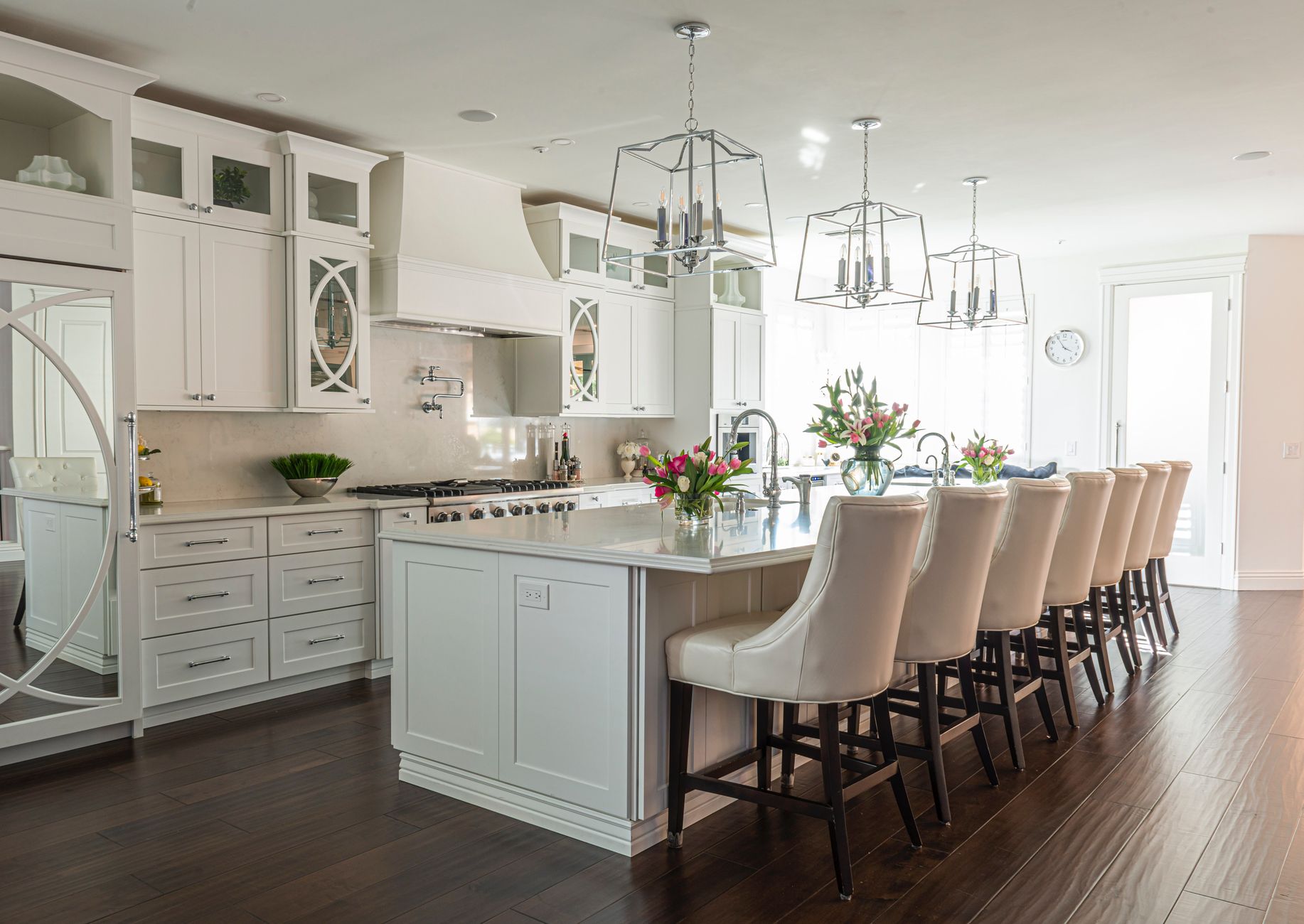
Pick up any three kitchens that have under-cabinet lighting and you will find three different products: a flexible strip, a row of round pucks, a rigid linear bar. They all aim light at the counter, but they behave very differently once installed. Choosing between them comes down to how smooth the light needs to be, how much space is under the cabinet, and how the power gets there.
Flexible LED strips
A strip light is a thin ribbon with small LED chips mounted along it, usually sold on a reel and cut at marked intervals. It sticks to the underside of the cabinet with adhesive backing, tucks behind a lip or a light rail, and can bend around corners. Strips are the thinnest option, which matters when the cabinet has only a shallow rail to hide behind.
The difference between strips lies in chip density. A strip with chips spaced widely apart can show a row of bright dots reflected on a glossy counter or backsplash, a pattern often called scalloping. A strip with closely spaced chips, or one fitted inside a frosted channel, makes a smooth continuous line. Anyone installing strips over polished stone should either buy a high-density product or mount it in a diffuser channel.
Strips also come in different voltage types. Low-voltage strips need a separate power supply, while some products run on the household supply through a dedicated driver. Check which one the product uses before buying cable and connectors, because the two are not interchangeable.
Pucks
Pucks are small round fixtures, a few inches across, that attach to the cabinet bottom with screws. Each puck throws a circular pool of light. Spaced evenly, pucks produce a pattern of overlapping discs on the counter, which some people like for its decorative effect and others dislike because it looks spotty.
They are a practical choice when a cabinet bottom is deep and flat, and when the wiring can be run to each fixture. Pucks have the advantage of being easy to replace individually, since each one is its own unit. On the other hand, they sit proud of the cabinet bottom and can be visible from the side, and if one fails the pattern is broken until it is swapped.
Pucks work well inside glass-front cabinets and over display shelves too, where a pool of light on one object is the point.
Linear bars
A linear bar is a rigid fixture, often an extruded aluminum body with a lens, in standard lengths. It mounts with clips or screws, and many models connect end to end in a continuous run. The lens spreads the light evenly, so the counter gets a smooth band with no dots, and the bar sits in a fixed position that is easy to aim consistently.
Bars are usually thicker than strips, so measure the clearance under the cabinet before choosing. Some are slim enough to hide behind a rail of half an inch, while others need more depth. Bars also make cutting to length harder, since they come in fixed sizes, so the cabinet run may not match any available length exactly. Many products solve this with small joiner pieces or short filler sections.
Where to place the light under the cabinet
Position matters as much as the product. Mount the fixture toward the front edge of the cabinet bottom, not the back. A fixture at the back lights the backsplash and creates a glare on shiny tile while leaving the front of the counter dim. A fixture near the front throws light down and slightly back, where the hands are working.
If the cabinet has a decorative rail along its front edge, the light can hide behind it, and the rail blocks the view of the source from a standing position. Without a rail, a small strip of molding attached for this purpose accomplishes the same thing.
Drivers and power
LED lighting runs on direct current at a low voltage, so most under-cabinet products need a driver, sometimes called a transformer, to convert household power. The driver has to be rated for the total load of everything connected to it, with some headroom. A driver that runs near its maximum can overheat and fail early, so common advice is to size it comfortably above the total wattage of the connected lights.
The driver also needs a home. It should be accessible for replacement, ventilated, and not buried in a sealed box. Typical spots include the top of an upper cabinet, inside a cabinet beside the light run, or in a soffit with an access panel. Wire from the driver to each fixture is low voltage and thin, so run it along edges where it will not be pinched by a door or drawer.
Hardwired versus plug-in
Hardwired installations bring power to the fixtures through a junction box in the wall or cabinet, with the switch on the wall. This looks the cleanest, because no cord is visible, and the lights can be controlled from a normal switch or dimmer. It is the better choice during a remodel while walls are open.
Plug-in products connect through a cord to a nearby outlet. They suit rental kitchens and retrofits where opening walls is impractical. The cord can be hidden behind a molding strip along the underside of the cabinet, and a small in-line switch or remote handles on and off. The downside is an extra outlet in use and a slightly less finished look.
The longer project articles on kitchen remodeling carlsbad record show real kitchens where each approach was chosen for a specific reason, which helps when the options still seem equal.
Dimming and control
Under-cabinet lights are some of the most useful lights to dim, because they are often the only light left on in the evening. The dimmer must be compatible with the driver, and the driver must be rated for dimming, so check both before purchase. Without matching parts, expect flicker, buzz or a limited range.
Some kitchens add a motion sensor or a wireless switch so the lights come on automatically as someone approaches the counter. These work well but add another component that needs to match the system.
Color temperature and rendering
Pick a color temperature that matches the ceiling lights and any pendants. A mismatch is most visible on the counter, where both sources hit the same surface. Also check the color rendering index, since cheap strips sometimes show food in dull colors even when the temperature looks right.
Which one fits which kitchen
- A strip in a diffuser channel suits a shallow cabinet rail and a glossy counter.
- A linear bar suits a long, straight run where smooth light and a clean look matter most.
- Pucks suit glass cabinets, display shelves and deep cabinet bottoms where discrete pools of light are acceptable.
- Plug-in kits suit rentals and retrofits, and hardwired runs suit remodels with open walls.
Test the choice with a short sample length held in place before ordering the full run. Seeing the light on the actual counter shows whether the pattern, the color and the glare are acceptable, and it costs only a few minutes.